Hiring a hotel photographer is an important decision. The photographs you commission will influence how potential guests perceive your hotel, what they expect from their stay and, ultimately, whether they choose to book.
But how do you know which photographer is right for your hotel?
Most hotel owners and marketing managers will naturally start by looking at a photographer’s portfolio, checking their experience and comparing prices. These are all sensible things to do, but they don’t necessarily tell you whether that photographer can create images that will genuinely connect with your future guests.
Having worked as a professional hotel photographer, I believe there’s one fundamental difference between a good photographer and a great hotel photographer.
A good photographer shows people what your hotel looks like. A great hotel photographer shows people how it feels to stay there.
That distinction should shape the questions you ask before hiring.
Here are the questions I believe every hotel should ask a photographer, why they matter and what you should look for in their answers.
1. How Do You Differentiate Yourself From Other Hotel Photographers?
This is probably the most revealing question you can ask.
Any competent professional photographer should be able to produce technically excellent images. They understand exposure, composition, lighting, equipment and editing. Their photographs will be considerably better than those taken by an amateur.
But technical excellence alone isn’t enough.
I’ve seen plenty of technically impressive photographs of hotels that leave me feeling absolutely nothing.
The rooms are perfectly lit. The beds are beautifully made. Everything is sharp, straight and professionally presented.
Yet the photographs don’t make me want to stay there.
What’s missing is emotion.
Great Hotel Photography Creates a Feeling
When someone is considering booking a hotel, they’re not simply purchasing a room for the night.
They’re looking forward to an experience.
That experience might be romance, relaxation, luxury, escape, adventure, comfort or a sense of being looked after.
The most effective hotel photographs communicate those feelings before the guest has even arrived.
When I photograph a hotel, my objective isn’t simply to document its facilities. It’s to create photographs that emotionally resonate with the people the hotel wants to attract.
I want potential guests to look at an image and imagine themselves there.
A photograph of a bedroom should do more than demonstrate the size of the bed or the layout of the furniture. It should communicate something about the experience of spending a night in that room.
That’s what separates a photograph that merely provides information from one that creates desire.
What to Look for in the Photographer’s Answer
When you ask a photographer how they differentiate themselves, listen carefully.
Do they talk exclusively about their equipment, years of experience, technical skills or editing techniques?
Or do they talk about your guests, your brand, the feelings you want to communicate and how their photographs can help you attract bookings?
Technical competence is essential, but it’s only the starting point.
You want someone who understands the emotional role photography plays in hotel marketing.
2. What Is Your Process for Creating Emotionally Engaging Hotel Photography?
This question takes the conversation a step further.
It’s easy for a photographer to say that they create beautiful, atmospheric or emotionally engaging images.
But how do they actually achieve that?
Do they have a clear creative process, or do they simply arrive with their camera and photograph whatever looks attractive?
For me, the process begins long before I pick up a camera.
I Start by Asking Two Questions
When I begin working with a hotel, two of my most important questions are:
- How do you want your guests to feel?
- What experiences do your guests most enjoy?
I also want to understand the hotel’s brand.
For me, a brand is closely connected to the feeling a business wants people to associate with it.
A country house hotel might want to communicate warmth, tranquillity and understated luxury.
A contemporary city hotel might want to convey energy, sophistication and excitement.
A woodland retreat might want guests to feel that they’re escaping everyday life.
These feelings are not interchangeable, and the photography shouldn’t be either.
Once I understand what the hotel wants to communicate, I translate those feelings and experiences into a carefully planned shot list.
Every photograph should have a purpose.
Case Study: Photographing the Feeling of Escape
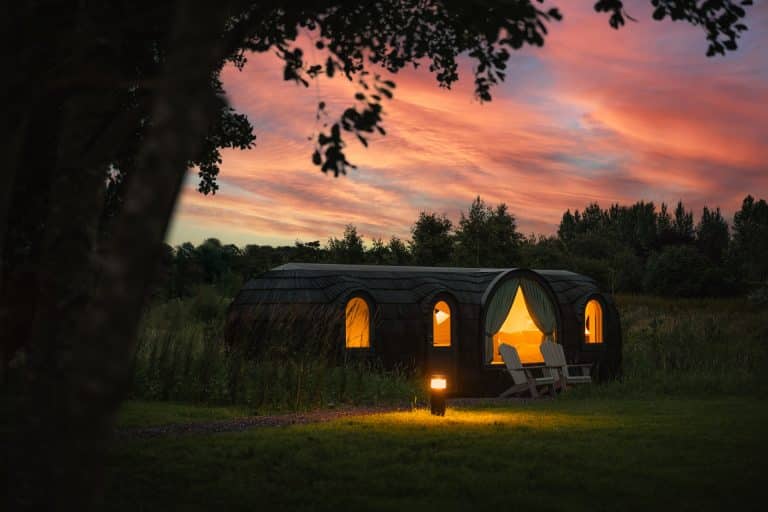
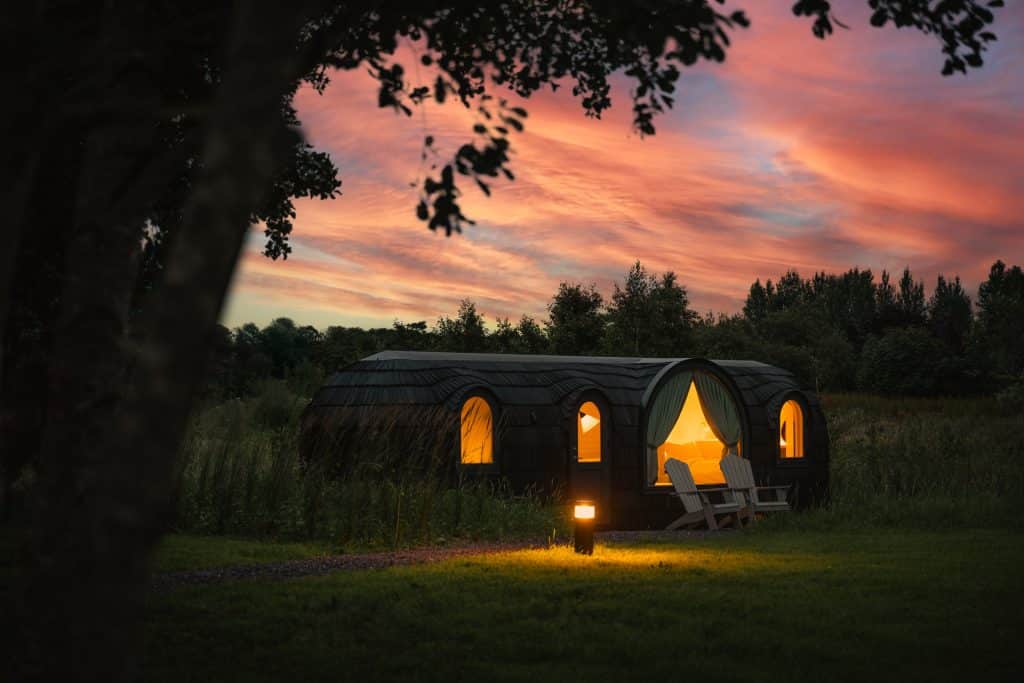
One example of this approach was a photograph I created of a woodland cabin.
The experience I wanted to communicate was escape.
Rather than photograph the cabin during the middle of the day, when everything would be clearly visible, I chose to photograph it at dusk.
The cabin was surrounded by woodland, with no other buildings or people visible.
The lights were switched on inside, creating a warm, inviting glow against the darker surroundings.
The evening sky added another layer of atmosphere.
Every element was chosen deliberately.
The absence of people and nearby buildings communicated privacy and seclusion. The surrounding darkness created a sense of separation from the outside world. The warm interior lighting suggested comfort, safety and welcome.
The photograph wasn’t simply showing potential guests what the cabin looked like.
It was inviting them to imagine escaping to it.
That is what I mean by emotionally engaging hotel photography.
Ask the Photographer to Explain Their Images
When reviewing a photographer’s portfolio, don’t just ask yourself whether you like their photographs.
Ask the photographer why they made particular creative decisions.
- Why did they choose that time of day?
- Why was the room photographed from that angle?
- Why were people included or excluded?
- What feeling were they trying to create?
An experienced hotel photographer should be able to explain the thinking behind their images and how those decisions support the hotel’s brand.
If they can explain why a photograph works, rather than simply telling you that it looks beautiful, that’s a very encouraging sign.
3. Having Looked at Our Website, How Do You Think Our Brand Is Being Communicated Through Photography, and What Would You Improve?
This is one of my favourite questions for a hotel to ask a prospective photographer.
It reveals whether the photographer has taken the time to understand your business and whether they can think beyond the individual photograph.
Your hotel’s website is often where potential guests form their first meaningful impression of the experience you’re offering.
The photography plays an enormous role in that impression.
But is it communicating the right message?
Your Photography Should Reflect Your Brand
Imagine your hotel prides itself on providing a peaceful, restorative escape.
Your existing website might contain perfectly competent photographs of bedrooms, bathrooms, reception areas and dining rooms.
But do those photographs communicate peace and restoration?
Or do they simply show the physical spaces?
There is a difference.
A photographer who understands branding should be able to look at your existing imagery and identify opportunities to communicate the guest experience more effectively.
They might suggest photographing the hotel at a different time of day, introducing people into certain scenes, showing more of the surrounding landscape or focusing on experiences rather than facilities alone.
The important thing is that their suggestions should be connected to your brand and the guests you want to attract.
A Photographer Should Bring Ideas to the Conversation
When I discuss a project with a hotel, I’m interested in more than the number of bedrooms that need photographing.
I want to understand what makes the property special.
What do guests remember most fondly about staying there?
Which experiences generate the most enthusiasm?
What makes someone choose this hotel instead of another property nearby?
These conversations often uncover opportunities that might otherwise have been missed.
Perhaps guests particularly love enjoying a drink beside the fire after a long walk.
Perhaps the hotel’s gardens are especially beautiful in the evening.
Perhaps the breakfast experience is one of the most memorable parts of a stay.
These details can become powerful photographic opportunities.
The purpose of the photography is to make those experiences visible and desirable to people who haven’t yet visited.
Look for Someone Who Challenges Your Thinking
A good hotel photographer shouldn’t simply agree with every suggestion you make.
They should be prepared to contribute ideas based on their experience.
That doesn’t mean imposing their own artistic preferences on your hotel.
It means understanding your objectives and suggesting creative ways to achieve them.
Sometimes the most valuable contribution a photographer makes happens during the planning conversation, before a single photograph has been taken.
4. How Will You Plan and Prepare for Our Photoshoot?
If there’s one piece of practical advice I’d give every hotel commissioning photography, it’s this:
80% of the work is done before the photographer arrives on site.
In my experience, inadequate preparation is one of the biggest mistakes hotels make when organising a photoshoot.
A photographer can be highly skilled, but if rooms aren’t ready, staff haven’t been briefed, props are missing or nobody has decided exactly what needs to be photographed, valuable shooting time disappears.
And once that time is gone, you can’t get it back.
Indecision Is the Silent Time Killer
I’ve learned that one of the biggest obstacles to a productive hotel photoshoot isn’t a technical problem.
It’s indecision.
Arriving at a location and only then deciding what should be photographed, how it should look, who needs to be involved and what needs to be prepared can consume an enormous amount of time.
It interrupts the creative process and reduces the number of quality photographs that can be captured.
That’s why I put so much emphasis on planning.
By the time I arrive at a hotel, I want everyone involved to understand what we’re trying to achieve.
We should be able to hit the ground running.
The Shot List Is Central to Everything
For me, the shot list is one of the most important documents in the entire photography process.
And I don’t mean a simple list that says:
- Bedroom
- Restaurant
- Bar
- Exterior
- Spa
That’s a list of locations, not a properly developed photography plan.
A detailed shot list should identify:
- The photograph: Exactly what image we want to create.
- The location: Where the photograph will be taken.
- The feeling: What emotion or experience the image needs to communicate.
- The props: What objects, furniture, food, flowers or other details are required.
- The people: Whether staff, guests or models need to appear in the image.
- The preparation: What needs to be arranged before the photographer arrives.
- The responsibility: Who will make sure everything is ready.
This level of detail transforms a photoshoot from a series of improvised decisions into an organised creative project.
It also makes the day much more efficient.
Why I Recommend Creating a Mood Board
Whenever possible, I also recommend developing a mood board.
A mood board is a collection of visual references that helps communicate the intended style, atmosphere and emotional direction of the photography.
It allows everyone to see what we’re trying to create rather than relying entirely on verbal descriptions.
For example, one person’s idea of luxury might be dramatic lighting, rich colours and opulent interiors.
Another person’s idea of luxury might be simplicity, space, beautiful natural light and calm.
Neither approach is necessarily wrong, but they communicate very different experiences.
A mood board helps ensure we’re all working towards the same vision.
Review the Plan Together Before the Shoot
Once the shot list and mood board are prepared, I review them with the client.
This is an essential part of the process.
It gives everyone the opportunity to contribute ideas, identify potential problems and agree on priorities.
It also ensures the hotel team understands what will be required of them.
If a dining scene needs specific food, table settings and members of staff, those arrangements can be made in advance.
If a particular room needs to be photographed at a specific time because of the light, the hotel can plan around that requirement.
Preparation gives us more time to concentrate on creating great photographs.
And ultimately, that means better value for the hotel.
Case Study: Ballykealey House
My photography project at Ballykealey House is a good example of how careful preparation contributes to a successful shoot.
Planning the photography in advance meant we could coordinate the creative direction, styling, props and locations before the shoot began.
Having a clear idea of the images we wanted to produce made the time on site much more productive.
It also allowed us to respond to changing conditions without losing sight of the overall objective.
The result was a cohesive collection of photographs designed to communicate the character and experience of the property.
You can see the project in my Ballykealey House photography case study.
My advice to any hotel is simple: when speaking to photographers, ask to see an example of how they plan a shoot.
Ask whether they provide a detailed shot list and mood board.
Ask how they coordinate with your staff and how they make sure everything is ready.
Their answers will tell you a great deal about how professionally they approach their work.
5. How Will Your Photography Help Us Attract More Guests and Direct Bookings?
Ultimately, hotels invest in professional photography for a reason.
They want to attract guests.
Beautiful photographs are valuable, but photographs that create a desire to stay at your hotel are far more powerful.
That is where I believe the real commercial value of hotel photography lies.
Photography Should Create Desire
Think about how people browse hotel websites or social media.
They often look through numerous properties, comparing rooms, facilities, prices and locations.
Much of this browsing happens quickly.
A photograph that simply documents a room might provide useful information, but it may not be enough to hold someone’s attention.
An emotionally engaging photograph can make someone stop scrolling.
It encourages them to look a little longer.
And, importantly, it can make them begin imagining the experience of staying there.
They might picture themselves enjoying a quiet weekend away, relaxing beside the fire or waking up to a beautiful view.
That moment of emotional connection is incredibly valuable.
It changes the question in the potential guest’s mind from “What does this hotel offer?” to “Wouldn’t it be lovely to stay there?”
Better Photography Can Support More Direct Bookings
There’s another important commercial consideration.
Hotels often rely on Online Travel Agencies (OTAs) to generate bookings.
These platforms can be valuable sources of business, but they also charge commissions.
When a guest books directly through a hotel’s website, the hotel can avoid or reduce some of those distribution costs.
I believe emotionally engaging photography can play an important part in encouraging direct bookings.
If the images on your website create a strong desire to stay, they give visitors another reason to continue through to your booking engine rather than returning to an OTA to compare alternatives.
Of course, photography is only part of the equation.
Your website needs to be easy to use, your booking process needs to work well and your rates and offers need to be compelling.
But the photography has an important job to do: create the desire that motivates someone to take the next step.
That’s why I encourage hotels to think about photography as an investment in their marketing and brand, rather than simply a cost.
How Should You Measure the Value of Hotel Photography?
It’s not always possible to attribute a booking directly to an individual photograph.
There are many factors influencing a guest’s decision.
However, hotels can look at indicators such as:
- Whether visitors spend more time engaging with key pages on the website.
- Whether more visitors click through to the booking engine.
- Whether direct booking enquiries and conversions improve.
- Whether the new imagery performs better in advertising and social media campaigns.
- Whether the hotel is attracting the type of guests it most wants to reach.
These measures won’t prove that photography alone caused an improvement, but they can help you understand how your new images contribute to your overall marketing performance.
For me, the most important question remains: Do these photographs make someone want to stay at this hotel?
If they don’t, it doesn’t matter how technically perfect they are.
6. How Can the Photography Process Help Strengthen Our Hotel Brand?
This is a question that hotels might not initially think to ask, but I believe it’s one of the less obvious benefits of working with an experienced hotel photographer.
The planning process itself can help a hotel develop a clearer understanding of its brand.
When I ask a hotel how it wants guests to feel, or which experiences guests enjoy most, these questions encourage the management team to think carefully about what makes their property distinctive.
That thinking has value beyond the photography.
Photography Forces You to Define the Experience
It’s easy for a hotel to describe itself using familiar words such as luxurious, welcoming, relaxing or unique.
But what do those words actually mean in the context of your property?
If your hotel promises relaxation, which specific experiences create that feeling?
Is it the peaceful gardens, the comfortable bedrooms, the spa, the friendly staff or the opportunity to disconnect from everyday life?
Once those experiences have been identified, we can design photographs that communicate them.
But the process also gives the hotel a clearer understanding of what it should be promoting.
In that sense, planning a photoshoot can become a useful brand-development exercise.
It encourages the hotel to move beyond describing its facilities and start thinking about the experience it’s really selling.
Your Photographs Can Also Become a Benchmark for Staff
There’s another benefit I’ve come to appreciate.
The photographs created during a professional hotel shoot can serve as a visual benchmark for the team working at the property.
Think about a beautifully prepared guest bedroom.
The photograph doesn’t just exist to attract potential guests.
It can also show housekeeping staff exactly how the room should be presented.
The position of the cushions, arrangement of furniture, placement of accessories and overall feeling of the space are all clearly documented.
The same principle applies to restaurants, bars and other guest experiences.
A well-planned photograph can provide a visual reference for how a space should look and what atmosphere the hotel is aiming to create.
This can help create consistency between what guests see when booking and what they experience when they arrive.
And that consistency matters.
Photography shouldn’t promise an experience the hotel can’t deliver. It should communicate the best version of the experience the hotel genuinely offers.
7. What Should Be Included in a Hotel Photography Quote?
Naturally, price will be part of your decision.
But I would caution against comparing quotes based solely on the cost of the photographer’s time on site.
Two photographers might quote for the same number of shooting days while offering very different levels of service.
One might simply arrive, take the photographs and deliver the edited images.
Another might invest substantial time understanding your brand, developing the creative direction, preparing a detailed shot list, creating a mood board, coordinating requirements and planning how to maximise the shoot.
Those are not necessarily equivalent services.
Questions to Ask About the Quote
Before accepting a proposal, make sure you understand:
- Does the quote include pre-shoot planning and creative consultation?
- Will the photographer help us prepare a detailed shot list?
- How many shooting days or hours are allowed?
- How many finished photographs can you reasonably expect?
- What level of editing and retouching is included?
- What usage rights will you receive for the photographs?
- Can the images be used on your website, social media, booking platforms and in advertising?
- Are travel, accommodation, assistants, models or styling costs included?
- What happens if poor weather affects important outdoor photographs?
- When will the finished images be delivered?
These are practical questions that help avoid misunderstandings later.
However, I would also consider the value of the photographer’s creative thinking and experience.
A well-prepared shoot can produce more useful images in the available time, while a carefully considered collection of photographs can serve your hotel across many different marketing channels.
The cheapest quotation doesn’t necessarily represent the best value.
8. Can You Show Us a Relevant Hotel Photography Project and Explain Your Approach?
A portfolio is an essential part of choosing a photographer.
But rather than simply looking at a selection of their most impressive images, ask them to walk you through an actual hotel photography project.
Ideally, choose one that has something in common with your own property.
Look Beyond Individual Hero Images
Almost any photographer can assemble a portfolio of their strongest work.
What you really want to understand is whether they can deliver a complete collection of images that work together.
A hotel needs more than one spectacular photograph.
It needs a cohesive visual story across bedrooms, restaurants, public spaces, exteriors, facilities and guest experiences.
Ask the photographer:
- What was the hotel’s brief?
- What experience were you trying to communicate?
- How did you plan the shoot?
- What challenges did you encounter?
- Why did you make particular creative decisions?
- How did the finished photographs support the hotel’s brand?
The answers should reveal much more than a collection of attractive pictures.
They should demonstrate the photographer’s ability to understand a client’s objectives and translate those objectives into purposeful imagery.
9. How Will You Work With Our Hotel Team During the Shoot?
Hotel photography is a collaborative process.
Even the most experienced photographer can’t produce the best possible results without support from the hotel.
Rooms need to be prepared, locations need to be accessible, food may need to be presented, staff may need to be available and various departments may need to coordinate their activities.
All of this has to happen while the hotel continues looking after its guests.
This is another reason I put so much emphasis on advance planning.
Everyone Should Know Their Responsibilities
By the time the shoot begins, the team should understand which areas will be photographed, when they need to be ready and what preparation is required.
For example, if we’re photographing a restaurant experience, the relevant staff should already know whether we’ll need specific table settings, dishes, drinks or people in the scene.
If we’re photographing bedrooms, housekeeping should understand how the rooms need to be prepared and when they’ll be required.
This reduces disruption and allows everyone to work more efficiently.
It also means the photographer can spend more time concentrating on the creative work rather than solving avoidable organisational problems.
A good photographer should be able to explain how they will coordinate with your team and minimise disruption to the hotel.
10. What Makes a Successful Hotel Photoshoot?
I believe the answer to this question should be established before the shoot, not afterwards.
Too often, the success of photography is judged simply by how many images were delivered or whether everyone likes the pictures.
Of course, image quality and quantity matter.
But a successful hotel photoshoot should achieve something more meaningful.
It should produce a collection of photographs that clearly communicates the hotel’s brand, creates desire among potential guests and provides useful marketing assets for the business.
Agree on the Objectives Before the Camera Comes Out
Before starting a project, I’d encourage hotel owners and marketing managers to consider:
- What do we want potential guests to feel when they see our photographs?
- What experiences do we most want to promote?
- Who are the guests we’re trying to attract?
- Where will the images be used?
- Which photographs are most important to our marketing strategy?
- What would make this investment worthwhile for our hotel?
These questions help ensure the photography is being created with a clear purpose.
They also provide a useful reference point when reviewing the finished work.
Success isn’t simply having a new collection of beautiful photographs.
It’s having photographs that work for your hotel.
Final Thoughts: Hire a Photographer Who Understands the Experience You’re Selling
Choosing a hotel photographer shouldn’t come down to price, camera equipment or even the attractiveness of their portfolio alone.
The most important consideration is whether they understand what makes your hotel special and can translate that into photographs that connect emotionally with potential guests.
Ask how they differentiate themselves.
Ask how they create emotion in their images.
Ask what they think your existing photography communicates about your brand.
Ask how they plan and prepare for a shoot.
And ask how their approach will help your hotel attract the guests you want.
Their answers will tell you a great deal about whether they’re simply a good photographer or someone who can genuinely contribute to your hotel’s marketing.
For me, hotel photography always comes back to one idea.
People don’t just book a hotel because of what it looks like. They book because of how they imagine it will make them feel.
The job of a great hotel photographer is to bring that feeling to life.
If you’re considering new photography for your hotel, Tadhg Nathan Photography would be delighted to discuss the experience you want to communicate and how we could create photographs that make potential guests want to be there.